Why Students Fear Failure


My 6th grade daughter’s lowest grade during the first quarter was in PE. Her mom and I aren't overly concerned with her grade, though, as it was due to her time running the mile. As I sometimes do, I began making connections between her experience and what sometimes happens in classrooms.

Let's first go back in time to our junior high PE days. Imagine the following scenario:

Today, your PE teacher is showing you how to shoot a free throw. When he is done, you will then go to a basket and shoot 10 free throws. Your grade for this assignment will be based on how many shots you make today. There will be little-to-no feedback, and tomorrow you’ll move on to the next lesson. You were shown how to shoot the free throw, so the skill should be learned and proficiency ready to be demonstrated. You may be told mistakes are okay, but your grade is permanent and based on your abilities immediately after the coach’s instruction.

Sounds familiar? Probably so but not from PE class. This scenario likely played out many times in other classes. As a former math teacher, I regrettably admit this was a common experience of my students. I taught the lesson, assigned work, and collected it the next day to be graded - often times without quality feedback. Students who already understood the material or who “learned quicker” received higher scores. Some may have achieved mastery at a later time, but their scores were lower because learning wasn't demonstrated soon enough – according to my pre-determined learning deadlines. 

It was also common for me to preach that failure is okay. Afterall, we learn from our failures. However, students would learn that failing too early in the learning process meant lower grades. 

Failure wasn't really okay, and I failed to recognize my responsibility in providing feedback in a timely manner.

I could’ve been better, and my students deserved better from me. At that time, grades weren’t about the learning. Grading was done because…well…that’s just a part of school. And feedback? That takes too much time. 

I recently read Making Assessment Work: For Educators Who Hate Data but Love Kids by David Schmittou. In that book, he says:

“If a kid shows today that they can earn a higher grade than they earned three weeks ago, change it. This just shows that you did an excellent job of teaching and inspiring hope. It is not an indictment of the kid. It’s a celebration of your ability to teach.”

May our practices demonstrate we value mistakes and feedback more than grades and pre-determined learning deadlines. By truly rewarding mastery, and the path to get there, we can inspire hope by sending the message that learning is the ultimate treasure.


Doug Dunn is currently athletic director and junior high principal for the Licking (MO) School District. He has previously served as a K-8 superintendent and elementary principal. Doug can be found on Twitter at DougDunnEdS.

Reevaluating Reading Instruction


In Leading with Focus, author Mike Schmoker says "research shows that the acquisition of knowledge and vocabulary through content-rich curriculum may be more important to reading than any other factor." This content and vocabulary can come from a variety of sources. In his book Focus, Schmoker shares that a content-rich curriculum must include regular, in-class opportunities to read and discuss newspapers, serious magazines, biographies, memoirs, etc. He also writes "no evidence proves that an approach focused on the technical aspects of literacy helps students become more sophisticated in their reading.” Reading growth depends, more than anything, on our ability to build up students' knowledge base and vocabulary.

Why do I mention Schmoker's work on literacy? Because the Edutopia article below includes reading growth in one of their 10 most significant educational studies of 2020. A K-5 study indicates that "social studies is the only subject with a clear, positive, and statistically significant effect on reading improvement." I don't know many details of the study, but the results should definitely cause us to ask questions.


Doug Dunn is currently athletic director and junior high principal for the Licking (MO) School District. He has previously served as a K-8 superintendent and elementary principal. Doug can be found on Twitter at DougDunnEdS.

Improving Society Through Literacy Instruction


Vicki Davis, “The Cool Cat Teacher,” once shared the following on social media:
    • Nearly 85% of the juveniles who face trial in the US juvenile court system are functionally illiterate.
    • More than 60% of all US inmates are functionally illiterate.
    • 53% of 4th graders admit they read recreationally “almost every day” while only 20% of eighth graders say the same.
    • Teenage girls between 16 to 19 who live at or below the poverty line and have below average literacy skills are six times more likely to have children out of wedlock than girls their age who read proficiently.
So, I challenge you to look at reading differently. It isn’t a standard. It is an essential to living a better life. When you help a child become a better reader, you are helping them live a better life.

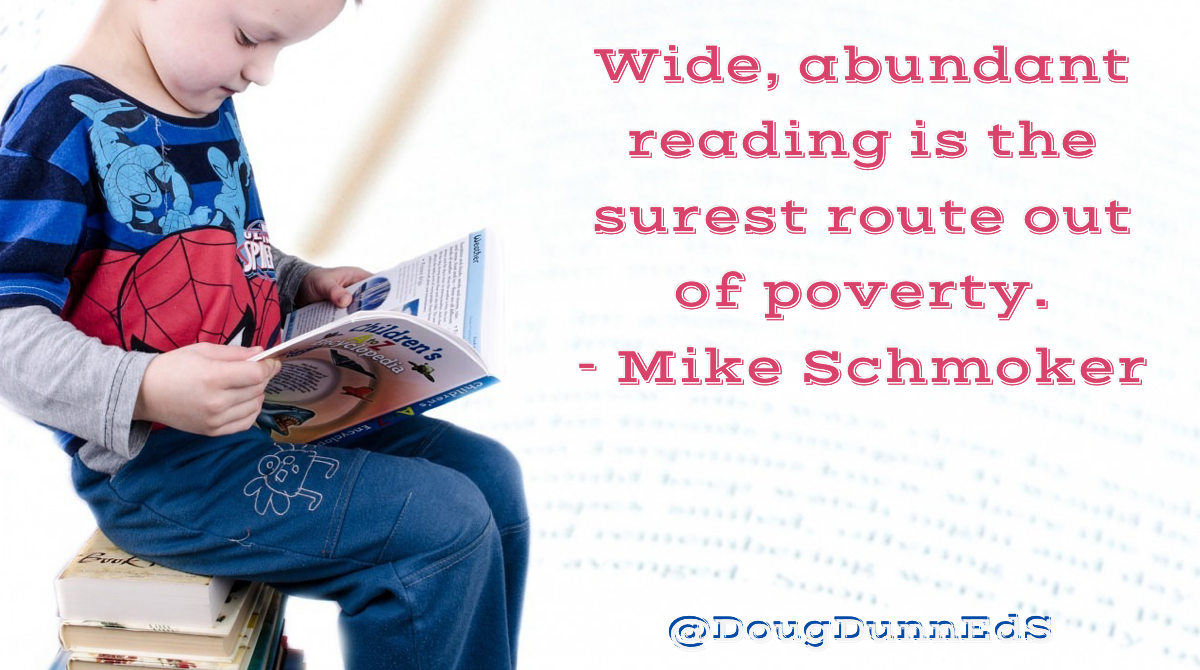
I have written previously about the importance of literacy and hiring teachers who are passionate about literacy instruction. Both are extremely important. When Mike Schmoker says “Wide, abundant reading is the surest route out of poverty,” there is an abundance of research supporting his claim.

It is imperative we reach students early and often. Phonics instruction is critical. But, we can’t stop there.

In his book Leading with Focus, Schmoker says “Research shows that the acquisition of knowledge and vocabulary through content-rich curriculum may be more important to reading than any other factor.” This research should impact the way we view literacy instruction. We are all literacy teachers and should be teaching literacy through our specific content areas.

In my first week at a new school, I observed multiple teachers infusing their own personal reading passions into their classrooms. This must also be a regular occurrence across grade levels and content areas if we’re going to make a huge dent in the statistics above. 

We can’t instill a love of literacy into others if we don’t have the passion ourselves.


It begins with us. I agree with Donalyn Miller when she says, “Being a master reading teacher begins with being a master reader.” We must model lifelong learning through reading.

As teachers, we should all strive to be master reading teachers by combining personal reading passions with a curriculum that is rich in content and vocabulary. 

If we’re in the business of changing lives, few things will have the impact we desire like changing the way many of us view literacy instruction.


Doug Dunn is currently athletic director and junior high principal for the Licking (MO) School District. He has previously served as a K-8 superintendent and elementary principal. Doug can be found on Twitter at DougDunnEdS.

The Value of a Coach

“Why does our school need an instructional coach? If our teachers need coaching, they shouldn’t be here!” 

This was a comment by a school board member at a previous school. Much could be said in response to this perspective on education, but I want to briefly share some thoughts on the statement. The truth is, teachers are professionals and professionals in many fields benefit from the expertise and perspectives of coaches.

As a lifelong St. Louis Cardinals fan, I still follow the career of Albert Pujols – arguably the greatest right-handed hitting baseball player of all-time. In the post-game conference after tying Willie Mays for 5th on the all-time homerun list, Pujols credited his hitting coaches with helping him make adjustments prior to the historic achievement. Albert Pujols, also known as “The Machine,” still finds value from utilizing coaches. It’s what professionals do. Tom Brady has a quarterback coach. Tiger Woods benefits from golf coaches. Being coached is not reserved for the less talented. Being coached is about moving from where we are to some place better. 

Teaching should be no different. The expertise of a good instructional coach is invaluable, and a good one can take teaching to higher levels. When this happens, a teacher’s impact improves through increased and deeper student learning. 

Just like professional athletes, teachers should continue growing no matter how many years they’ve been in their profession. Risk-taking and lifelong learning should be modeled in every classroom.

Truthfully, each one of us in education, no matter our role, should make learning, reflecting, and growing a part of our what we do. It’s the only way to keep providing students a high-quality education. For teachers, instructional coaches are able to help facilitate this in a high-quality manner that is non-threatening and non-evaluative. They also help protect us from complacency and status quo.  

Being coached is what professionals do. 


Doug Dunn is currently athletic director and junior high principal for the Licking (MO) School District. He has previously served as a K-8 superintendent and elementary principal. Doug can be found on Twitter at DougDunnEdS.

Teacher, Lean On Me


Educators have always needed each other. Whether that need is an understanding ear or a helping hand, the empathy of a colleague can be just what we need to keep us going. This year more than any, we must be intentional about seeking and sharing encouragement. We are all being asked to do more than what has been typical. In a sense, we are first year educators all over again.

In her book Dare to Lead, Brene Brown shares a study which was conducted with a group of military members who constantly felt exhausted by the demands of their work. The study found they were actually exhausted from loneliness. Not just loneliness from their families, but loneliness from connections and inclusion among those with which they served.

This should serve as a valuable lesson for educators. The demands and stress of balancing in-class instruction, distance learning, social distancing, extra sanitation efforts, and the coming and going of quarantined students may challenge us like never before. For many, it will feel like we’re living in a constant state of exhaustion and loneliness. 

We need to be intentional about checking in on and encouraging one another. Sometimes, though, we will be the ones in need. Now is not the time to let pride get in the way and keep us from seeking help. Our sanity demands that we stay connected and lean on each other. 

As the study Brene Brown shared suggests, perhaps by doing these things we can muster the extra energy needed to get through this year and provide our students the level of education they need and deserve. Perhaps, too, that same extra energy will allow us to have something left in the tank when we return home to our families. 

We can’t do this alone. This school year will require us to lean on one another like never before. Let’s be intentional with serving and encouraging each other. May we also be intentional with seeking help when we need it. 

We won’t regret encouraging others or being encouraged by others. However, we will have regrets if we try to get through this school year alone.


Doug Dunn is currently athletic director and junior high principal for the Licking (MO) School District. He has previously served as a K-8 superintendent and elementary principal. Doug can be found on Twitter at DougDunnEdS.