Improving Society Through Literacy Instruction


Vicki Davis, “The Cool Cat Teacher,” once shared the following on social media:
    • Nearly 85% of the juveniles who face trial in the US juvenile court system are functionally illiterate.
    • More than 60% of all US inmates are functionally illiterate.
    • 53% of 4th graders admit they read recreationally “almost every day” while only 20% of eighth graders say the same.
    • Teenage girls between 16 to 19 who live at or below the poverty line and have below average literacy skills are six times more likely to have children out of wedlock than girls their age who read proficiently.
So, I challenge you to look at reading differently. It isn’t a standard. It is an essential to living a better life. When you help a child become a better reader, you are helping them live a better life.

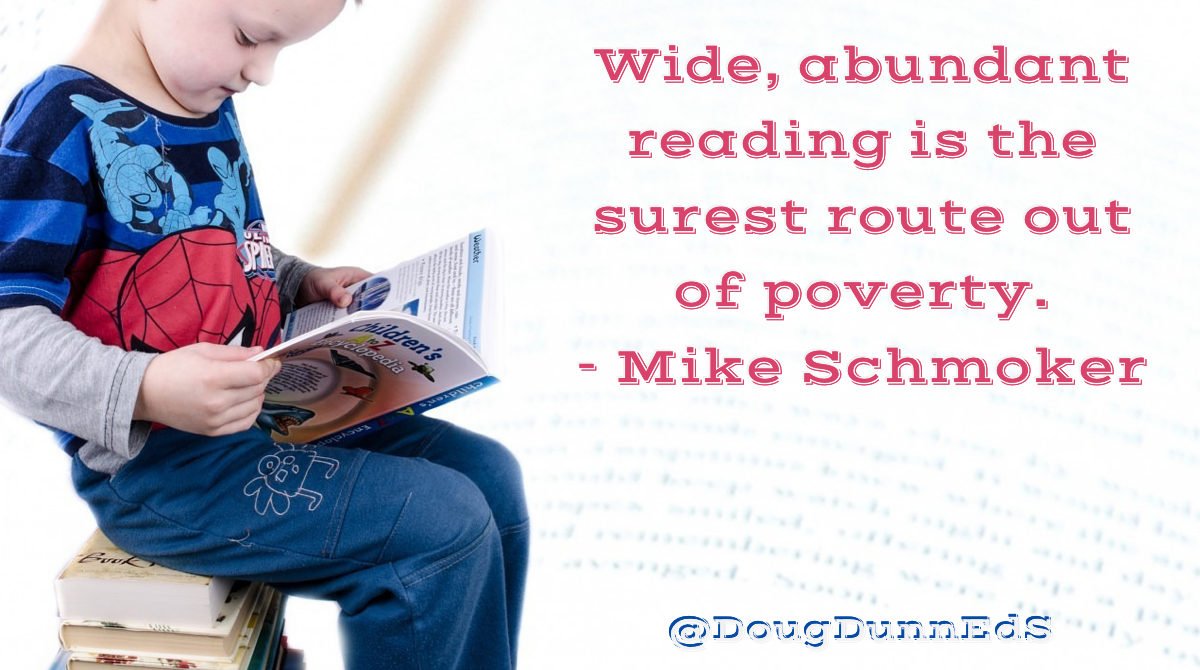
I have written previously about the importance of literacy and hiring teachers who are passionate about literacy instruction. Both are extremely important. When Mike Schmoker says “Wide, abundant reading is the surest route out of poverty,” there is an abundance of research supporting his claim.

It is imperative we reach students early and often. Phonics instruction is critical. But, we can’t stop there.

In his book Leading with Focus, Schmoker says “Research shows that the acquisition of knowledge and vocabulary through content-rich curriculum may be more important to reading than any other factor.” This research should impact the way we view literacy instruction. We are all literacy teachers and should be teaching literacy through our specific content areas.

In my first week at a new school, I observed multiple teachers infusing their own personal reading passions into their classrooms. This must also be a regular occurrence across grade levels and content areas if we’re going to make a huge dent in the statistics above. 

We can’t instill a love of literacy into others if we don’t have the passion ourselves.


It begins with us. I agree with Donalyn Miller when she says, “Being a master reading teacher begins with being a master reader.” We must model lifelong learning through reading.

As teachers, we should all strive to be master reading teachers by combining personal reading passions with a curriculum that is rich in content and vocabulary. 

If we’re in the business of changing lives, few things will have the impact we desire like changing the way many of us view literacy instruction.


Doug Dunn is currently athletic director and junior high principal for the Licking (MO) School District. He has previously served as a K-8 superintendent and elementary principal. Doug can be found on Twitter at DougDunnEdS.

The Value of a Coach

“Why does our school need an instructional coach? If our teachers need coaching, they shouldn’t be here!” 

This was a comment by a school board member at a previous school. Much could be said in response to this perspective on education, but I want to briefly share some thoughts on the statement. The truth is, teachers are professionals and professionals in many fields benefit from the expertise and perspectives of coaches.

As a lifelong St. Louis Cardinals fan, I still follow the career of Albert Pujols – arguably the greatest right-handed hitting baseball player of all-time. In the post-game conference after tying Willie Mays for 5th on the all-time homerun list, Pujols credited his hitting coaches with helping him make adjustments prior to the historic achievement. Albert Pujols, also known as “The Machine,” still finds value from utilizing coaches. It’s what professionals do. Tom Brady has a quarterback coach. Tiger Woods benefits from golf coaches. Being coached is not reserved for the less talented. Being coached is about moving from where we are to some place better. 

Teaching should be no different. The expertise of a good instructional coach is invaluable, and a good one can take teaching to higher levels. When this happens, a teacher’s impact improves through increased and deeper student learning. 

Just like professional athletes, teachers should continue growing no matter how many years they’ve been in their profession. Risk-taking and lifelong learning should be modeled in every classroom.

Truthfully, each one of us in education, no matter our role, should make learning, reflecting, and growing a part of our what we do. It’s the only way to keep providing students a high-quality education. For teachers, instructional coaches are able to help facilitate this in a high-quality manner that is non-threatening and non-evaluative. They also help protect us from complacency and status quo.  

Being coached is what professionals do. 


Doug Dunn is currently athletic director and junior high principal for the Licking (MO) School District. He has previously served as a K-8 superintendent and elementary principal. Doug can be found on Twitter at DougDunnEdS.

Teacher, Lean On Me


Educators have always needed each other. Whether that need is an understanding ear or a helping hand, the empathy of a colleague can be just what we need to keep us going. This year more than any, we must be intentional about seeking and sharing encouragement. We are all being asked to do more than what has been typical. In a sense, we are first year educators all over again.

In her book Dare to Lead, Brene Brown shares a study which was conducted with a group of military members who constantly felt exhausted by the demands of their work. The study found they were actually exhausted from loneliness. Not just loneliness from their families, but loneliness from connections and inclusion among those with which they served.

This should serve as a valuable lesson for educators. The demands and stress of balancing in-class instruction, distance learning, social distancing, extra sanitation efforts, and the coming and going of quarantined students may challenge us like never before. For many, it will feel like we’re living in a constant state of exhaustion and loneliness. 

We need to be intentional about checking in on and encouraging one another. Sometimes, though, we will be the ones in need. Now is not the time to let pride get in the way and keep us from seeking help. Our sanity demands that we stay connected and lean on each other. 

As the study Brene Brown shared suggests, perhaps by doing these things we can muster the extra energy needed to get through this year and provide our students the level of education they need and deserve. Perhaps, too, that same extra energy will allow us to have something left in the tank when we return home to our families. 

We can’t do this alone. This school year will require us to lean on one another like never before. Let’s be intentional with serving and encouraging each other. May we also be intentional with seeking help when we need it. 

We won’t regret encouraging others or being encouraged by others. However, we will have regrets if we try to get through this school year alone.


Doug Dunn is currently athletic director and junior high principal for the Licking (MO) School District. He has previously served as a K-8 superintendent and elementary principal. Doug can be found on Twitter at DougDunnEdS.

Happy Accidents - Myth or Reality?


“We don’t make mistakes. We have happy accidents.” ~ Bob Ross

How are mistakes viewed in your classroom? A good litmus test would be how students respond when a mistake is made. Are they concerned about losing points or potential consequences? Or, do your students embrace mistakes because they are opportunities for growth?

Hopefully students view mistakes as learning opportunities. If not, it is critical that we address whatever is getting in the way. 

Mistakes Are Okay

How many students have experienced a teacher saying mistakes are okay only to lose points on an assignment that was graded too soon in the learning process? They have learned those who “learn quicker” get higher grades. Students should have opportunities to make mistakes and receive feedback before they’re graded for content knowledge or application. Otherwise, mistakes truly aren’t okay. One goal of education is to learn knowledge and skills and how to apply them to new situations. Unfortunately, our system is not set up to best celebrate those who learn...but rather those who learn quicker than others. 

Happy Accidents

Are “happy accidents” a myth or reality in your classroom? Every teacher should evaluate his or her classroom practices to determine if mistakes truly are encouraged and embraced. I believe that it is impossible to genuinely embrace mistakes as part of the learning process if grading occurs before students have had the opportunity to learn from feedback.

We should not allow traditional grading practices to get in the way of powerful learning opportunities. If a student has already been penalized with a poor grade, they no longer believe there is an incentive to continue learning. In fact, learning stops once a grade is received. Feedback and extending questions are needed to further learning.

When students feel free to make mistakes, only then can mistakes become happy accidents which boost learning.

I’ll close with a couple of quotes from John Hattie:

1) A grade is an announcement, not feedback. 

2) If kids aren’t making mistakes, there isn’t much learning going on. 

May we all be challenged to boost the volume of feedback we provide while establishing cultures which truly do embrace mistakes as part of the learning process.


Doug Dunn is currently athletic director and junior high principal for the Licking (MO) School District. He has previously served as a K-8 superintendent and elementary principal. Doug can be found on Twitter at DougDunnEdS.

If I Had A Different Mom

“Mom, you’re the best mom ever!”

“But, if I had a different mom she’d be the best mom ever.”

She was six years old at the time, but our middle daughter recognized that a different mom would likely make her feel as loved and important as she does now. It was not to say she wished for a different mother. Not at all. It was another example for us of her amazing empathetic understanding of people and the world around her.

We all want people in our lives who will love us, meet our needs, and give us attention. Young people are no different. When students say “Ms. So-and-So is the best teacher ever,” what they’re really saying is they appreciate how that teacher made them feel. How they took time to get to know them and care about them. Perhaps even how they made their content come alive. But, ultimately, it’s about feeling loved, safe, respected, and important.

Have you ever noticed an elementary student say every year that their current teacher is the “best teacher ever?” Students do not have a deep understanding of pedagogy, curriculum, etc., but they do understand the feeling they get when they’re in a caring teacher’s classroom. 

Anybody can be that caring person in the life of a child.

This is by no means an exhaustive list, but below are some ways we can be a positive influence on the students we serve.
  • Greet students at the door with a smile and some form of “hello.”
  • Get to know them – their interests, passions, strengths, weaknesses, dreams, fears, etc.
  • Talk to them about topics unrelated to school or content.
  • Recognize and celebrate their achievements – large or small. 
  • Offer praise and encouragement.
  • Show up to their after-school activities.
  • Call them by their first name. As Dale Carnegie says in How to Win Friends and Influence People, “the sweetest sound to a person’s ear is the sound of their own name.”
  • Give fist bumps or high fives.

I made a quick run to Walmart last summer for supplies I needed for yard work. While there, I ran into the aunt of a student who told me how much her nephew enjoyed me being his principal. The reason was because I gave him a fist bump and called him by name on a regular basis. This junior high student was impacted in such a way he shared it with his family. 

When my wife and I served as house parents at a children’s home, we made a point to have dinner with everyone around the table each evening. There were no electronic devices. It was just us, as a family unit, talking about our day and whatever else may be on our minds. The girls in our home said evening mealtime was one of the things they appreciated and valued the most. Some even said they had never experienced that before.

Young people crave personal connection. They want to feel recognized, loved, respected, valued, and supported. They want to know that they matter to somebody. And, it’s best if that “somebody” is one who can be a positive influence.

We can, and should, be that influence in the lives of our students.

As Josh Shipp says, “every kid is one caring adult away from being a success story.”

Being a caring adult will make you “the best teacher ever” in the eyes of your students. And, who knows? You may just inspire a child to greatness because of it.


Doug Dunn is currently athletic director and junior high principal for the Licking (MO) School District. He has previously served as a K-8 superintendent and elementary principal. Doug can be found on Twitter at DougDunnEdS.