Do Your Students Feel Like They Matter & Have Value?

As I returned to the classroom last week, I’ve reflected on interactions I’ve had with students as I seek to get to know them and help them get to know me. As educators, our interactions with students are critical in building relationships, modeling appropriate communication, and establishing connections that encourage students to strive for greatness. 

One negative experience a student has with an adult can undo a lot of good and be very difficult to overcome. 

Throughout my 20+ years in education I have come to believe:
  • All students should be treated with dignity and respect.
  • We should speak to and treat students as if their parents were right there with us.
  • If we wouldn't say it in front of their parents, we shouldn't say it in front of anybody else.
We must remember that our students are not finished products. They will make mistakes and disappoint us. However, it is important that we continue providing them a consistent, encouraging environment every day. 

It is possible to maintain high expectations and hold them accountable while extending both love and grace. 

The magnitude of our mission is great. May all of our students feel like they matter and have value when they’re around us.


Doug Dunn has over 20 years of experience in education as a classroom teacher and administrator. After ten years of serving in multiple administrative positions, including elementary principal, junior high principal, athletic director, and superintendent, Doug returned to the classroom this year to reclaim some of the joy in education that cannot be replicated in the office. He currently teaches high school algebra and coaches girls basketball at Steelville (MO) High School. Doug can be found on Twitter at DougDunnEdS.

This post was originally published on August 28, 2023.

What Blockbuster Can Teach Us About Fostering a Love of Reading


My two oldest daughters recently purchased their very first books at an actual bookstore. Yes, we’ve gone to the library and purchased online before, but this was a new experience for them. We don’t have big bookstores where we live and made a point to stop at a Barnes & Noble during a recent trip. 

My middle child searched for over an hour and was on the verge of leaving without a book had it not been for a collective, determined effort to help her. My oldest daughter, however, found three books within the first ten minutes upon entering the store. 

I asked Ella how she settled on her books so quickly, and she responded that her friends had talked about them. Had it not been for these informal book talks, her experience that day would likely have been similar to her sister’s. 

This made me think of the good ol’ days of visiting the local movie store to rent movies. If we had no idea what we wanted to watch, we’d spend a great deal of time roaming the aisles and reading back covers before ultimately deciding on what to (or not to) rent. However, if somebody had told us about a good movie we’d likely go right to it hoping to find an available copy on the shelf. 

There is a lesson to be learned here when it comes to fostering a love of reading. Our kids need to experience more book talks at school. We cannot leave this to chance.

How often do teachers have a few spare moments here or there in class? When you consider the frequency in which students may be entertaining themselves on devices at the end of class time, it’s likely more often than we realize. These moments are great opportunities for students and teachers to talk about books and series they’ve read and enjoyed. 

If we want to foster a love of reading, we must be intentional with the experiences we facilitate. Book talks are quick, simple, and powerful ways to help do this. They could be done during the first 5 minutes of PE or at the end of class following an Algebra test. 

As educators, it’s up to all of us to help foster a love of reading. Our efforts could result in blockbuster impacts on our students.

Below are a few resources I’ve found online for book talk strategies and ideas:


Doug Dunn is currently junior high principal for the Licking (MO) School District. He has previously served as a K-8 superintendent and elementary principal. Doug can be found on Twitter @DougDunnEdS.

Responding to Adversity


https://drive.google.com/uc?export=view&id=1U8o9psKbhAuOLRhN2t8-Mq6d2AG5ZHi4

High school athletics can help teach and instill many character traits that will benefit students later in life in their quest for success. I reflected on this recently after being asked a very good question from a lady at church. 

The person asking the question had read a Facebook post where I expressed my gratitude for a particular group of parents I had while coaching. This group of parents never approached me with a criticism - either directly or indirectly. 

The question was “do you think they didn’t complain because all their kids got playing time?”

The simple answer is no. Throughout my 20+ years in public education, I have experienced or observed parents complaining about more than just playing time. Complaints or criticisms could come from what offense or defense you run, what position their child plays, an in-game adjustment, how many shots their child gets, how their child is substituted, and more. 

Several years ago, a team I was coaching trailed by three points in a game with just a few seconds remaining. I called a timeout and put my best three point shooters on the floor. I removed a particular player who was not a great shooter at the time. This grew the ire of his parents. They requested a meeting with me to complain about my decision to remove their son for the final shot. It was not a pleasant meeting. 

What transpired ended up being a beautiful thing. The young man became determined to never let that happen again. He didn’t rely on his parents to complain their way to more playing time or complain their way to influencing the coach’s decisions. No, this young man went to work. By the next season, he was one of the best shooters on the team. He took his frustrations into his own hands and made himself better. This, in turn, made his team better. 

I believe this is a great example from which all parents and players could learn. When things don’t go our way, we cannot complain our way to a solution - or at least a solution that benefits the team more than the individual. But what we can do is learn the “why” and get to work. 

When facing adversity, we don’t learn and grow when others move to the front lines for us to fight our battles. We learn and grow when we take an honest look at our circumstances and frustrations. We learn and grow when we stay on the front lines ourselves determined to improve in the areas that caused our frustration. 

Parents, it’s ok to let our children fail, struggle, or become frustrated. It’s our job as parents and coaches to help them learn determination and resiliency as they conquer their own adversity. In doing so, we help our children develop character traits that will benefit them for the rest of their lives.

https://drive.google.com/uc?export=view&id=1B1GKvrsjRQLltzZAiwvKh2emjHGAp1pR


Doug Dunn is currently junior high principal for the Licking (MO) School District. He has previously served as a K-8 superintendent and elementary principal. Doug can be found on Twitter @DougDunnEdS.

Too Few Students are Proficient: What is Broken?

We often hear stories in the news about student proficiency rates. More often than not, that data is shared in a negative manner. Or, the news results in a negative perception. For instance, back in the fall it was shared that 45% of Missouri students were proficient or advanced in English, 35% in math, and 37% in science. 

This looks and sounds pretty bad. Why would the media or politicians share this? Could hidden agendas drive the creation and sharing of negative data? You can draw your own conclusions on that. 

So what does “proficient” mean in regards to student achievement? I highly doubt anybody can give a clear, obvious answer. It’s an arbitrary target that isn’t easily defined. 

One may wonder how proficiency levels are determined. The truth may surprise you, and it will likely leave you doubting the validity of such statistics. 

I once had a teacher participate in a state group tasked with determining what score students needed in order to be classified as proficient. Each test for each grade level had its own group, and each group created its own, independent scores for proficiency. Her particular group worked hard to agree on what score they felt students needed to reach proficiency status. Keep in mind this was a collection of expert teachers who taught that particular grade level and subject. They submitted their score to the state department - who responded by instructing them to try again because “too many students would be proficient at that level.” Yes, you read that correctly. The score expert teachers provided would result in “too many” students being proficient. They were instructed to raise their score so fewer students would achieve proficiency status. 

Crazy!!!

Established proficiency levels truly are arbitrary goalposts. Each state sets their own criteria, so you can’t use that data to fairly compare states. 

And, because the state has actually told teaching experts to establish a score that would reduce the number of students being classified as proficient, you cannot put too much weight into the data you hear about. Politicians have agendas. Media outlets have agendas. And, yes, departments of education sometimes have agendas. Many people want society to believe education is broken. 

Education is not broken! In fact, there has never been a time in our country’s history that a higher percentage of students have graduated from high school. Never. Are there areas in which schools could improve to better prepare students for life beyond K-12 education? Absolutely. But, our system isn’t broken. What is broken is how our teachers are not supported by society. What is broken is how our young people are being discouraged from entering the profession. What is broken is how our schools are underfunded - how teachers are underpaid. What is broken is how so many try to tear us down. Eventually, they could succeed and there would be nobody left to teach our young people. This terrifies me. 

People have their reasons for sharing misleading data about schools. We cannot believe everything we hear. 

Education is not broken.


https://drive.google.com/uc?export=view&id=1wNWDr-cbCsd-VGQxPzUcfrCbwhJDL1yO


Doug Dunn is currently athletic director and junior high principal for the Licking (MO) School District. He has previously served as a K-8 superintendent and elementary principal. Doug can be found on Twitter @DougDunnEdS.

What Schools Needs from Society

I recently spoke with a new teacher’s aide who hadn’t sat in a classroom since she was a student. Her eyes were opened to the unique challenges teachers face on a daily basis. A teacher’s job is both extremely rewarding and extremely challenging. Unfortunately, many are feeling the challenges outweigh the rewards…and choosing to leave. There are a number of reasons for this as teaching has always been hard. Now we have things like Covid and TikTok adding worries and stress. 

People who freely criticize educators and school systems speak without truly understanding what it is like on the inside. They often speak without first trying to understand. 

I once heard it said that “somebody who thinks they know how to teach because they were once a student is like somebody thinking they’re an expert plumber because they’ve flushed a toilet.” 

There’s already a critical shortage of teachers. Society must change how it treats and supports educators before the teacher shortage causes doors to close. It is imperative that teachers and schools are held in high regard like they used to be. 

What can society do?

1. Thank a teacher. Do this intentionally, sincerely, and often. 

2. Don’t claim to have the answers when lacking training, experience, or an understanding of research about what works best. This applies to everybody - including politicians. 

3. Don’t believe everything you hear. 

4. When you have a question or frustration, go to the source. Seek first to understand. Don’t assume you know the whole story and vent on social media (or anywhere). 

5. Support needed improvements at the ballot box. 

6. There used to be prestige to entering the teaching profession. Encourage our young people to become teachers. 

7. Become an active member in organizations that support local schools. Donate time and/or resources. 

8. Trust those who have training and experience.


Doug Dunn has over 20 years of experience as a teacher, coach, and administrator. He can be found on Twitter @DougDunnEdS

7 Things Teachers and Leaders Can Learn from Coaches


When we stop to analyze what coaches do on a regular basis to grow individual players and teams, it doesn’t take long to realize they are modeling excellent teaching and leadership strategies. Oftentimes they may not even realize this. It’s just what effective coaches do. 

We can all learn from our coaches, and I hope this reflection encourages all of us to step up our games as we seek to grow the students and teachers we serve.

Below are seven things great coaches do extremely well. 

Vision
Great coaches share their vision of high expectations for players and teams. Expectations for personal conduct, individual growth, and team success are discussed regularly during practices, games, and film sessions. A vision and subsequent expectations drive a team’s effort and commitment towards excellence. 

Communication
Great coaches are excellent communicators. Not only do they regularly communicate their vision and expectations, but they visit with players individually to offer feedback and evaluation. Their players have the opportunity to share what they believe to be their strengths and weaknesses, as well as how they envision their contributions to the team. Together, coaches and players set individual goals for improvement. Coaches will use these opportunities to share with their players what they see as their strengths, where they can grow, and how their contributions can benefit the team.

Relationships
Great coaches have a team of players who will “run through a brick wall” for them. This doesn’t happen by accident. Great coaches make a point to build relationships by: 
  • Offering regular encouragement
  • Demonstrating care, concern, and interest in their players as people
  • Providing players a voice on the team. Players appreciate when their perspective matters and when they’re empowered with freedoms and responsibilities. 

Feedback
Great coaches set an amazing example of providing effective feedback. The feedback is timely, purposeful, and followed by an opportunity to demonstrate understanding. It is common for coaches to stop practice multiple times to provide feedback to individuals and the team. Feedback also occurs in games during timeouts, at halftime, and when a player is resting on the bench. This feedback is driven by the vision and expectations which have already been shared by the coach, and understood and agreed upon by the players.

Modeling
Great coaches must first, and foremost, model expectations of excellence for personal conduct, character, and integrity. Great coaches are also effective at modeling what excellence (success criteria) looks like in their particular sport. They constantly model proper techniques while continuing to provide effective feedback. Players are then able to visualize what success looks like and use their new mental images to correct mistakes and grow as players. 

Micro-Teaching
Great coaches use video so players can see themselves in action. The conversations and feedback during film sessions can be extremely powerful at showing players where they’re performing very well and also areas which need improvement. 

Professional Learning
Great coaches are students of their craft. They constantly seek ways to help their players maximize potential. One way they do this is by searching for new drills to improve their players' fundamentals. Practice time is limited, so it is important to get the team game-ready in the most effective, most efficient manner possible. They observe what other coaches do in case there's something which could be implemented with their own team. Sometimes it's a drill, as mentioned, while other times it's an offensive or defensive set or scheme. If there's a way to make their players or teams better, they are quick to add it to their repertoire. Great coaches are constantly finding ways to learn more about their sport, coaching, and leadership. They do this by networking with other coaches, watching film, observing other coaches in action, reading coaching literature and playbooks, etc. Great coaches understand they do not have all of the answers and must constantly be learning and improving to give their players the best opportunity for success.


Each of the first six things are related to some of the most powerful influences on student achievement according to John Hattie’s Visible Learning Research. The hinge point in the Visible Learning Research is 0.40, which is one year’s growth for one year’s time. Below are effect sizes for some of the strategies mentioned above:
  • Vision, expectations, and goal-setting may be most closely related to Teacher Clarity which has an effect size of 0.75 - almost two years' worth of growth in one year’s time.
  • Student-teacher relationships have an effect size of 0.52.
  • Feedback has an effect size of 0.70. Modeling can also be an important component to feedback.
  • Micro-teaching has an effect size of 0.88.

As I reflect on these seven areas, I am reminded of the need for me to be better with each of them. Whether you serve as a coach, teacher, or administrator, how can these help you foster a culture of growth and excellence?


Doug Dunn is currently athletic director and junior high principal for the Licking (MO) School District. He has previously served as a K-8 superintendent and elementary principal. Doug can be found on Twitter at DougDunnEdS.

Why Students Fear Failure


My 6th grade daughter’s lowest grade during the first quarter was in PE. Her mom and I aren't overly concerned with her grade, though, as it was due to her time running the mile. As I sometimes do, I began making connections between her experience and what sometimes happens in classrooms.

Let's first go back in time to our junior high PE days. Imagine the following scenario:

Today, your PE teacher is showing you how to shoot a free throw. When he is done, you will then go to a basket and shoot 10 free throws. Your grade for this assignment will be based on how many shots you make today. There will be little-to-no feedback, and tomorrow you’ll move on to the next lesson. You were shown how to shoot the free throw, so the skill should be learned and proficiency ready to be demonstrated. You may be told mistakes are okay, but your grade is permanent and based on your abilities immediately after the coach’s instruction.

Sounds familiar? Probably so but not from PE class. This scenario likely played out many times in other classes. As a former math teacher, I regrettably admit this was a common experience of my students. I taught the lesson, assigned work, and collected it the next day to be graded - often times without quality feedback. Students who already understood the material or who “learned quicker” received higher scores. Some may have achieved mastery at a later time, but their scores were lower because learning wasn't demonstrated soon enough – according to my pre-determined learning deadlines. 

It was also common for me to preach that failure is okay. Afterall, we learn from our failures. However, students would learn that failing too early in the learning process meant lower grades. 

Failure wasn't really okay, and I failed to recognize my responsibility in providing feedback in a timely manner.

I could’ve been better, and my students deserved better from me. At that time, grades weren’t about the learning. Grading was done because…well…that’s just a part of school. And feedback? That takes too much time. 

I recently read Making Assessment Work: For Educators Who Hate Data but Love Kids by David Schmittou. In that book, he says:

“If a kid shows today that they can earn a higher grade than they earned three weeks ago, change it. This just shows that you did an excellent job of teaching and inspiring hope. It is not an indictment of the kid. It’s a celebration of your ability to teach.”

May our practices demonstrate we value mistakes and feedback more than grades and pre-determined learning deadlines. By truly rewarding mastery, and the path to get there, we can inspire hope by sending the message that learning is the ultimate treasure.


Doug Dunn is currently athletic director and junior high principal for the Licking (MO) School District. He has previously served as a K-8 superintendent and elementary principal. Doug can be found on Twitter at DougDunnEdS.

Reevaluating Reading Instruction


In Leading with Focus, author Mike Schmoker says "research shows that the acquisition of knowledge and vocabulary through content-rich curriculum may be more important to reading than any other factor." This content and vocabulary can come from a variety of sources. In his book Focus, Schmoker shares that a content-rich curriculum must include regular, in-class opportunities to read and discuss newspapers, serious magazines, biographies, memoirs, etc. He also writes "no evidence proves that an approach focused on the technical aspects of literacy helps students become more sophisticated in their reading.” Reading growth depends, more than anything, on our ability to build up students' knowledge base and vocabulary.

Why do I mention Schmoker's work on literacy? Because the Edutopia article below includes reading growth in one of their 10 most significant educational studies of 2020. A K-5 study indicates that "social studies is the only subject with a clear, positive, and statistically significant effect on reading improvement." I don't know many details of the study, but the results should definitely cause us to ask questions.


Doug Dunn is currently athletic director and junior high principal for the Licking (MO) School District. He has previously served as a K-8 superintendent and elementary principal. Doug can be found on Twitter at DougDunnEdS.

Improving Society Through Literacy Instruction


Vicki Davis, “The Cool Cat Teacher,” once shared the following on social media:
    • Nearly 85% of the juveniles who face trial in the US juvenile court system are functionally illiterate.
    • More than 60% of all US inmates are functionally illiterate.
    • 53% of 4th graders admit they read recreationally “almost every day” while only 20% of eighth graders say the same.
    • Teenage girls between 16 to 19 who live at or below the poverty line and have below average literacy skills are six times more likely to have children out of wedlock than girls their age who read proficiently.
So, I challenge you to look at reading differently. It isn’t a standard. It is an essential to living a better life. When you help a child become a better reader, you are helping them live a better life.

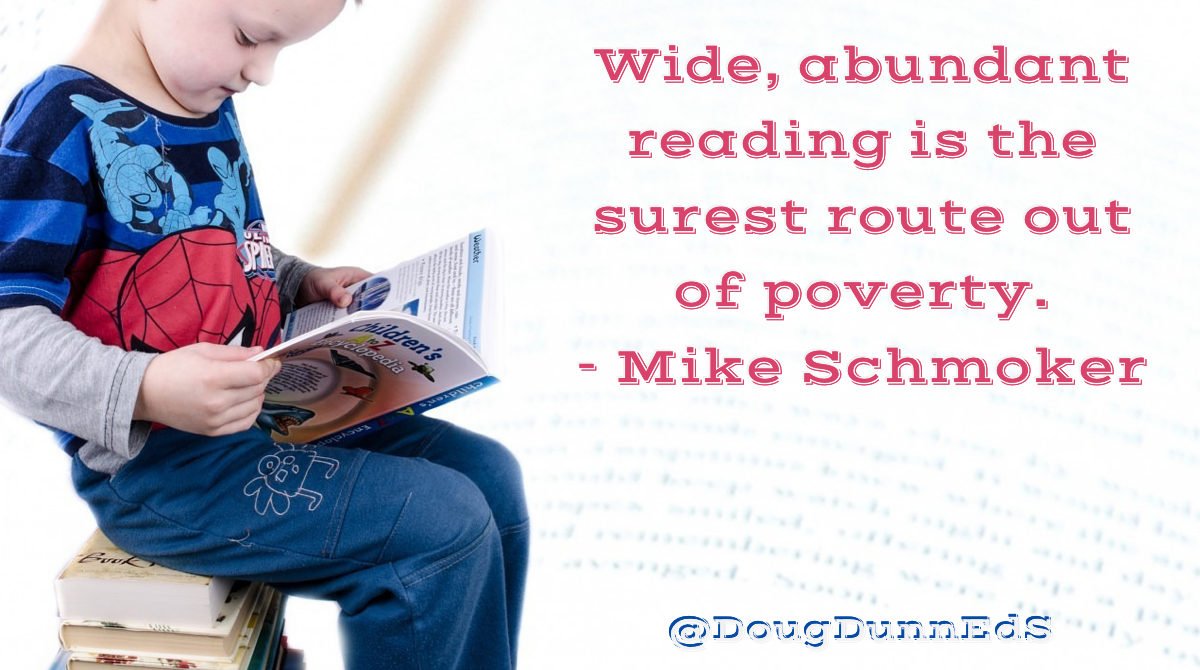
I have written previously about the importance of literacy and hiring teachers who are passionate about literacy instruction. Both are extremely important. When Mike Schmoker says “Wide, abundant reading is the surest route out of poverty,” there is an abundance of research supporting his claim.

It is imperative we reach students early and often. Phonics instruction is critical. But, we can’t stop there.

In his book Leading with Focus, Schmoker says “Research shows that the acquisition of knowledge and vocabulary through content-rich curriculum may be more important to reading than any other factor.” This research should impact the way we view literacy instruction. We are all literacy teachers and should be teaching literacy through our specific content areas.

In my first week at a new school, I observed multiple teachers infusing their own personal reading passions into their classrooms. This must also be a regular occurrence across grade levels and content areas if we’re going to make a huge dent in the statistics above. 

We can’t instill a love of literacy into others if we don’t have the passion ourselves.


It begins with us. I agree with Donalyn Miller when she says, “Being a master reading teacher begins with being a master reader.” We must model lifelong learning through reading.

As teachers, we should all strive to be master reading teachers by combining personal reading passions with a curriculum that is rich in content and vocabulary. 

If we’re in the business of changing lives, few things will have the impact we desire like changing the way many of us view literacy instruction.


Doug Dunn is currently athletic director and junior high principal for the Licking (MO) School District. He has previously served as a K-8 superintendent and elementary principal. Doug can be found on Twitter at DougDunnEdS.

The Value of a Coach

“Why does our school need an instructional coach? If our teachers need coaching, they shouldn’t be here!” 

This was a comment by a school board member at a previous school. Much could be said in response to this perspective on education, but I want to briefly share some thoughts on the statement. The truth is, teachers are professionals and professionals in many fields benefit from the expertise and perspectives of coaches.

As a lifelong St. Louis Cardinals fan, I still follow the career of Albert Pujols – arguably the greatest right-handed hitting baseball player of all-time. In the post-game conference after tying Willie Mays for 5th on the all-time homerun list, Pujols credited his hitting coaches with helping him make adjustments prior to the historic achievement. Albert Pujols, also known as “The Machine,” still finds value from utilizing coaches. It’s what professionals do. Tom Brady has a quarterback coach. Tiger Woods benefits from golf coaches. Being coached is not reserved for the less talented. Being coached is about moving from where we are to some place better. 

Teaching should be no different. The expertise of a good instructional coach is invaluable, and a good one can take teaching to higher levels. When this happens, a teacher’s impact improves through increased and deeper student learning. 

Just like professional athletes, teachers should continue growing no matter how many years they’ve been in their profession. Risk-taking and lifelong learning should be modeled in every classroom.

Truthfully, each one of us in education, no matter our role, should make learning, reflecting, and growing a part of our what we do. It’s the only way to keep providing students a high-quality education. For teachers, instructional coaches are able to help facilitate this in a high-quality manner that is non-threatening and non-evaluative. They also help protect us from complacency and status quo.  

Being coached is what professionals do. 


Doug Dunn is currently athletic director and junior high principal for the Licking (MO) School District. He has previously served as a K-8 superintendent and elementary principal. Doug can be found on Twitter at DougDunnEdS.

Teacher, Lean On Me


Educators have always needed each other. Whether that need is an understanding ear or a helping hand, the empathy of a colleague can be just what we need to keep us going. This year more than any, we must be intentional about seeking and sharing encouragement. We are all being asked to do more than what has been typical. In a sense, we are first year educators all over again.

In her book Dare to Lead, Brene Brown shares a study which was conducted with a group of military members who constantly felt exhausted by the demands of their work. The study found they were actually exhausted from loneliness. Not just loneliness from their families, but loneliness from connections and inclusion among those with which they served.

This should serve as a valuable lesson for educators. The demands and stress of balancing in-class instruction, distance learning, social distancing, extra sanitation efforts, and the coming and going of quarantined students may challenge us like never before. For many, it will feel like we’re living in a constant state of exhaustion and loneliness. 

We need to be intentional about checking in on and encouraging one another. Sometimes, though, we will be the ones in need. Now is not the time to let pride get in the way and keep us from seeking help. Our sanity demands that we stay connected and lean on each other. 

As the study Brene Brown shared suggests, perhaps by doing these things we can muster the extra energy needed to get through this year and provide our students the level of education they need and deserve. Perhaps, too, that same extra energy will allow us to have something left in the tank when we return home to our families. 

We can’t do this alone. This school year will require us to lean on one another like never before. Let’s be intentional with serving and encouraging each other. May we also be intentional with seeking help when we need it. 

We won’t regret encouraging others or being encouraged by others. However, we will have regrets if we try to get through this school year alone.


Doug Dunn is currently athletic director and junior high principal for the Licking (MO) School District. He has previously served as a K-8 superintendent and elementary principal. Doug can be found on Twitter at DougDunnEdS.

Happy Accidents - Myth or Reality?


“We don’t make mistakes. We have happy accidents.” ~ Bob Ross

How are mistakes viewed in your classroom? A good litmus test would be how students respond when a mistake is made. Are they concerned about losing points or potential consequences? Or, do your students embrace mistakes because they are opportunities for growth?

Hopefully students view mistakes as learning opportunities. If not, it is critical that we address whatever is getting in the way. 

Mistakes Are Okay

How many students have experienced a teacher saying mistakes are okay only to lose points on an assignment that was graded too soon in the learning process? They have learned those who “learn quicker” get higher grades. Students should have opportunities to make mistakes and receive feedback before they’re graded for content knowledge or application. Otherwise, mistakes truly aren’t okay. One goal of education is to learn knowledge and skills and how to apply them to new situations. Unfortunately, our system is not set up to best celebrate those who learn...but rather those who learn quicker than others. 

Happy Accidents

Are “happy accidents” a myth or reality in your classroom? Every teacher should evaluate his or her classroom practices to determine if mistakes truly are encouraged and embraced. I believe that it is impossible to genuinely embrace mistakes as part of the learning process if grading occurs before students have had the opportunity to learn from feedback.

We should not allow traditional grading practices to get in the way of powerful learning opportunities. If a student has already been penalized with a poor grade, they no longer believe there is an incentive to continue learning. In fact, learning stops once a grade is received. Feedback and extending questions are needed to further learning.

When students feel free to make mistakes, only then can mistakes become happy accidents which boost learning.

I’ll close with a couple of quotes from John Hattie:

1) A grade is an announcement, not feedback. 

2) If kids aren’t making mistakes, there isn’t much learning going on. 

May we all be challenged to boost the volume of feedback we provide while establishing cultures which truly do embrace mistakes as part of the learning process.


Doug Dunn is currently athletic director and junior high principal for the Licking (MO) School District. He has previously served as a K-8 superintendent and elementary principal. Doug can be found on Twitter at DougDunnEdS.

If I Had A Different Mom

“Mom, you’re the best mom ever!”

“But, if I had a different mom she’d be the best mom ever.”

She was six years old at the time, but our middle daughter recognized that a different mom would likely make her feel as loved and important as she does now. It was not to say she wished for a different mother. Not at all. It was another example for us of her amazing empathetic understanding of people and the world around her.

We all want people in our lives who will love us, meet our needs, and give us attention. Young people are no different. When students say “Ms. So-and-So is the best teacher ever,” what they’re really saying is they appreciate how that teacher made them feel. How they took time to get to know them and care about them. Perhaps even how they made their content come alive. But, ultimately, it’s about feeling loved, safe, respected, and important.

Have you ever noticed an elementary student say every year that their current teacher is the “best teacher ever?” Students do not have a deep understanding of pedagogy, curriculum, etc., but they do understand the feeling they get when they’re in a caring teacher’s classroom. 

Anybody can be that caring person in the life of a child.

This is by no means an exhaustive list, but below are some ways we can be a positive influence on the students we serve.
  • Greet students at the door with a smile and some form of “hello.”
  • Get to know them – their interests, passions, strengths, weaknesses, dreams, fears, etc.
  • Talk to them about topics unrelated to school or content.
  • Recognize and celebrate their achievements – large or small. 
  • Offer praise and encouragement.
  • Show up to their after-school activities.
  • Call them by their first name. As Dale Carnegie says in How to Win Friends and Influence People, “the sweetest sound to a person’s ear is the sound of their own name.”
  • Give fist bumps or high fives.

I made a quick run to Walmart last summer for supplies I needed for yard work. While there, I ran into the aunt of a student who told me how much her nephew enjoyed me being his principal. The reason was because I gave him a fist bump and called him by name on a regular basis. This junior high student was impacted in such a way he shared it with his family. 

When my wife and I served as house parents at a children’s home, we made a point to have dinner with everyone around the table each evening. There were no electronic devices. It was just us, as a family unit, talking about our day and whatever else may be on our minds. The girls in our home said evening mealtime was one of the things they appreciated and valued the most. Some even said they had never experienced that before.

Young people crave personal connection. They want to feel recognized, loved, respected, valued, and supported. They want to know that they matter to somebody. And, it’s best if that “somebody” is one who can be a positive influence.

We can, and should, be that influence in the lives of our students.

As Josh Shipp says, “every kid is one caring adult away from being a success story.”

Being a caring adult will make you “the best teacher ever” in the eyes of your students. And, who knows? You may just inspire a child to greatness because of it.


Doug Dunn is currently athletic director and junior high principal for the Licking (MO) School District. He has previously served as a K-8 superintendent and elementary principal. Doug can be found on Twitter at DougDunnEdS.

Why Your Administrator Appears to be Under Communicating or Not Listening

Stay in education long enough and you’ve likely either heard or said one of the following:

My principal doesn’t listen.

My principal doesn’t care. 

My principal doesn’t communicate enough (or well enough).

These are legitimate concerns, and effective communication is vital to the success of any organization. Most administrators truly are good people who are well-intended. However, their communication, or lack thereof, can become misinterpreted, misunderstood, taken personally, or perceived to be rooted in malice.

Below are a few reasons why administrators may appear to be under communicating or not listening:

They are trying to prevent more stress.

We all know teaching is stressful. Sometimes administrators choose to not share certain information to avoid adding additional stress onto teachers. It is important that teachers are able to maintain their focus on teaching. Some information will generate worry and stress that reduces a teacher’s effectiveness during planning and instruction. 

They are trying to respect your time.

Most administrators understand how demanding teaching is. There are demands placed on time, emotions, and energy. Administrators may attempt to keep from overburdening their staff by respecting and protecting a teacher’s valuable minutes during the day. 

The answer is no.

Sometimes an answer of “no” is interpreted as not listening or not caring. If the reason for a “no” was not shared, it’s okay to seek understanding. Seeking understanding is better than living with an incorrect assumption. 

They have poor body language/nonverbal communication.

Administration is a social position which requires building and maintaining relationships. Some administrators are natural introverts and live outside of their comfort zone each and every day. Their body language and nonverbal communication can sometimes be misinterpreted as not listening or not caring. 

They forgot.

Administrators are human, too. In the craziness of a given day, it is easy to forget something important. Sometimes I can’t even get out of my office before distractions prevent me from remembering where I was going. I often ask staff to send me an email reminder because I know how easy it can be for me to forget. This has proven to be helpful. 

They are stressed or busy, too.

Fulfilling a large number of responsibilities and obligations can be stressful and time-consuming. Teachers definitely understand this. Administrators often have to triage needs or requests as a teacher’s emergency may not be an administrator’s emergency at that moment. Critical discipline issues, central office directives, etc. can often dictate the degree of urgency for any given situation.


A lack of communication, or its perception, can only be improved by better communication - from both sides. While it is the responsibility of any leader to constantly work on improving his or her communication skills, there are some things that teachers should do when left feeling frustrated.

Practice patience.

Extend grace.

Follow up.

Assume good intentions.

Administrators and teachers serve on the same team, and good team members practice effective two-way communication. The four strategies listed above aren't just for teachers. Teachers need their administrators to practice patience, extend grace, follow up, and assume good intentions as well. If both sides are effective in these four areas, communication and culture will be greatly improved.

If communication is a struggle for you, it is important to develop an effective system. Emailing myself works for me. Whenever I have a thought or need a reminder, I pull my phone out and send myself an email which serves as a constant reminder each time my inbox is open. If I'm unable to email myself, I ask staff to email me a reminder. Your system may be different, but the important thing is developing something that will work for you (and those you serve).


Doug Dunn is currently athletic director and junior high principal for the Licking (MO) School District. He has previously served as a K-8 superintendent and elementary principal. Doug can be found on Twitter at DougDunnEdS.

3 Books to Enhance Your Teaching Tomorrow


Teaching is incredibly challenging and tiresome, and that’s often the result of many additional responsibilities which are not directly related to actual lesson planning and instruction. Teachers work hard, and there is not enough class time in a school year to adequately teach all of the expected standards. I don’t like to say “cover” the standards. Truthfully, it’s not about “teaching” the standards either. The ultimate goal of a teacher is to facilitate learning - not to teach or cover standards.

So how can we maximize the time we do have to achieve the greatest impact? 

I’ve been a firm believer for years that enhancing classroom instruction doesn’t have to take a major overhaul of what’s already occurring. It is possible that only a few minor tweaks are needed for tremendous impacts on learning and achievement.

Leaders often tell teachers to increase the amount and quality of student writing, become better questioners, or teach in a way that makes learning stick beyond the test. In some cases, there may be little to no support in helping educators grow in these areas. 

The three books below provide great blueprints for maximizing the time teachers have with students.


Focus: Elevating the Essentials to Radically Improve Student Learning (2nd Edition) by Mike Schmoker

Focus is one of my personal favorites, and even John Hattie has said Schmoker “lit a fire” with this book. In the first part of Focus, Schmoker shares what he has learned from his extensive research of schools that have made incredible gains in student achievement. He discovered three different areas of focus that schools have had throughout amazing turnarounds: guaranteed, viable curriculum, formative assessment, and increased literacy. The most impactful part of the book, in my opinion, is the 2nd half where Schmoker had dedicated chapters by content area. These chapters explain how teachers can increase the quantity and quality of reading, writing, and discussion/debating in reading, math, social studies, and science. His strategies are simple, applicable, and impactful. They can deepen learning, reduce grading, and increase student engagement.

At the end of last year, I purchased each of our teachers a copy of this book. Knowing it was unlikely every teacher would read Focus in its entirety, I encouraged them to read the chapter pertaining to their content area at some point prior to returning to school in August. Elementary teachers were to (at minimum) read the reading/ELA chapter. During one of our back to school meetings, we had a good discussion about literacy in our school. Specifically, we began to develop a plan to increase expectations for ourselves and our students in regards to the quality and quantity of writing students would produce. This was the starting point to addressing a gap we knew existed in our curriculum. 


Hacking Questions: 11 Answers That Create a Culture of Inquiry in Your Classroom by Connie Hamilton

Questioning is truly an art form, and it’s critical to increasing our students’ cognitive engagement. Unfortunately, it’s often a forgotten component in teacher prep programs and professional learning opportunities. For years we have been told as educators to increase the Depth of Knowledge (DOK) in our content standards while receiving very little, if any, quality training in how to effectively do so. Improving the quality of our questioning, and being purposeful with the type and timing of our questions, will move student thinking and learning deeper than we might have imagined was possible. 

Hacking Questions helps us learn how to:
  • Become more aware of the unintended messages we send to students through our current practices
  • Cognitively engage each and every student through our questioning
  • More effectively and efficiently gauge student learning and understanding
  • Avoid a culture of disengagement
  • Match our questions with our purpose
  • Engage our shy students
  • Respond to students who do not know an answer (or simply say “I don’t know”)
  • Become more intentional with closing a lesson and maximizing learning when students return the next day
  • Increase student reflection
  • Model how to use questioning to seek understanding
  • Help our students become better questioners
  • Help students break through struggle
  • Transfer ownership of questioning and learning to the students

Connie Hamilton does a terrific job of sharing her experiences while providing many applicable, effective strategies that can be implemented to improve questioning in the classroom. It’s a book every teacher should read before their first day of teaching, and it’s also one we should revisit regularly to finetune our questioning and move student understanding to deeper levels. More importantly, it’s a book that can help us teach our students how to become better questioners and learners themselves. 


Powerful Teaching: Unleash the Science of Learning by Pooja Agarwal and Patrice Bain

How often do we encourage our students to study for a test? How many of us have scolded students when they didn’t study? 

Do we teach students how to study or simply instruct or encourage them to do so? And, if we do teach them study techniques, what are those techniques based upon? How we studied when we were in school? Strategies we learned from our own parents or previous teachers? Research?

Yes, there is research about what works best to make learning stick. While some of the strategies proven to be effective by research may be unconventional, many traditional methods of studying simply do not work. 

Well, they may work for a test. But, as the authors of Make it Stick have said, “cramming leads to faster forgetting.” 

The authors of Powerful Teaching do a wonderful job of blending the science of learning with applicable, proven classroom strategies. In addition to providing teachers research-based methods to use in the classroom to make learning stick, the authors share effective studying techniques to teach our students to use in and out of the classroom. 

The biggest premise of the science of learning has to do with the purpose of the strategies. Many teachers have long thought the purpose of teaching was to impart knowledge to students. Learning science, and Powerful Teaching, stress that we need to focus more on pulling information out of our heads. We typically spend too much time trying to put information into students’ heads rather than have them practice pulling information out. We often view retrieval as a way to assess students, but Agarwal and Bain suggest that retrieval is a learning strategy - not an assessment strategy.

Powerful Learning details four main techniques based on research: retrieval, spacing, interleaving, and feedback-driven metacognition. The authors provide a myriad of classroom strategies that will help us maximize learning and take advantage of what research has shown to be more effective. Not only will students retain more, but their anxiety levels will decrease as well. 


Doug Dunn is currently junior high principal for the Licking (MO) School District. He has previously served as a K-8 superintendent and elementary principal. He can be found on Twitter at DougDunnEdS.

We Talkin' Bout Practice?!?


Yes, I’m going to talk about practice for a moment. Not about skipping practice as Allen Iverson famously did in 2002, but rather the importance of maximizing our time while in practice. As is the case with many things, there are parallels between the sports arena and the classroom. Whether you are a coach, classroom teacher, or administrator, my hope is that this post prompts reflection as we consider how to best utilize the short amount of time we actually have with our athletes, students, or staff. 

I was blessed to coach some extremely talented players and teams during my time as a head basketball coach. We experienced a great deal of success but had to do so in unconventional fashion. The year we won a state championship we only had seven players. That made it extremely challenging to practice in true, game-like conditions. But, we found a way to make it work. 

One of the reasons we were so successful during our two Final Four trips in 2004 and 2005 was due to free throw shooting. As a team, we shot over 75% both years during the Final Four. This was truly amazing! 

We must have made free throws a priority in practice, right? 

Not exactly.

Before I share a story I’ve never shared publicly before now, I must preface by saying this post is in no way intended to diminish the quality of individuals and players on the teams I coached. They were incredible young ladies who were very talented at basketball. They were tremendous kids, from tremendous families, and are all very successful in their own right today. I was extremely proud of them then and even more proud today. They are fine people and wonderful spouses and parents. 

This post is about acknowledging a weakness and then guiding a team through that known weakness. It’s also about having the courage to steer away from tradition in a pursuit of excellence. 

We were terrible free throw shooters. Our opponent in the state 3rd place game in 2004 knew that. Midway through the 4th quarter, I made the decision to hold the ball at halfcourt while on offense to force Mound City to get out of their suffocating 2-3 zone. Our 4-5 point lead seemed like much more, but I wanted to generate a larger lead to close out the game. I felt they couldn’t guard us man-to-man. Knowing we were 50% as a team shooting free throws, the opposing coach instructed his players to foul us rather than change their defense. We went to the free throw line and made both shots. 

Thinking he wouldn’t foul us again, we held the ball the next trip down the court. I was wrong. They fouled us to force more free throws.

Again, we made them both.

After this happened for a 3rd time, my mind was off to the races. What should I do? Everybody in the arena on the University of Missouri campus was watching and critiquing my coaching decisions in one of the biggest games in school history. Not much pressure!

Here’s a rundown of some of those thoughts…
  • We only had one senior, a non-starter, on our team. I knew we’d be favorites to win the state championship the following year. 
  • We were terrible free throw shooters, and I didn’t want free throws to keep us from winning a state championship next season.
  • I had been hounding our team about spending extra time before and after practice to address their weakness. Doing so was a rare occurrence, and I had grown frustrated during the season.

So, what adjustment did I make after being fouled on three consecutive trips down the court?

None!

In that moment, I was thinking about next year. Crazy, I know! We were in the 3rd place game in the state, and next year had no guarantees.

I leaned over to my assistant coach and said, “If we can’t make our free throws we don’t deserve to win.” I can’t believe I actually said that in the biggest game of my life. In my first season as a head coach. In a huge game for our school and community. That moment presented what I felt at the time was a win-win scenario. Either we win the 3rd place game in the Final Four, or our girls learn the hard lesson that they need to put in extra time shooting free throws. My efforts to convince them had fallen on deaf ears, so maybe the pain of losing and the hunger to return to the Final Four would motivate them. I still cannot believe I was okay with using that game as a teachable moment.

The game ended with us shooting a perfect 12/12 from the free throw line in the 4th quarter, and we won the game.

How in the world did that happen?

I was asked about that in the post-game press conference. How could we go 12-12 in the 4th quarter when we had been 50% as a team the entire season? It was a great question, and my answer revealed publicly that we had quit shooting free throws earlier in the season “because it wasn’t working.” 

Yes, I quit spending (wasting) practice time on free throws. If it wasn’t going to help us, our time needed to be spent on something which would have a greater impact. 

This is where I believe the lesson lies for teachers and coaches. As world-renowned educational researcher John Hattie likes to say, “It’s not about what works...it’s about what works best.”

Just as a teacher has limited time in a classroom with students, coaches have limited time with their players. We must maximize that brief amount of time with instruction, practice, and learning which will yield the greatest results.

For our team, there were more impactful drills we could be running than shooting free throws. The goal was to be as good of a team at the end of the season as we could be, and our practices needed to be designed for that purpose. I failed at inspiring them to put in the extra work on their own, but I could control the practice schedule.

Studies indicate that we grow more from focusing on our strengths than focusing on our weaknesses. I believe our teams were a true reflection of this. We used the time that would have been spent shooting free throws on things which would help us become better at what we were already good at - defense, rebounding, offensive efficiency, passing, and layups. 

There was still the occasional time in practice to shoot free throws in pressure situations, and this may have helped us during our state playoff runs. However, there was no longer time allotted for the mass shooting of free throws. This was difficult for me because I thought that is what coaches had their teams do. I played and learned under multiple hall-of-fame coaches and tried to mimic as much of what they did as possible. But, as is the case with every new team or class of students, we must adapt and evolve with the individuals and groups we lead. Their talents and needs are different, and we must be able to meet them where they are - not necessarily follow a prescribed recipe that may have worked with a previous group. 

There are times when that recipe should be replicated, but it’s important to recognize when it should be aborted. 

I began coaching stuck in tradition. That tradition was simply mimicking the way I had been taught. We frequently see this in sports and in the classroom. Coaches and teachers often do things for no other purpose than that’s how they were taught. Mass free throws? Piles of worksheets? Whatever the case, there are often better ways to utilize the time we have with others and maximize the growth of those we lead. The same is true for administrators leading teachers.

Tradition doesn’t always make you better. Oftentimes, it’s a roadblock to excellence. As administrators, coaches, and teachers, it is imperative that we do not allow our stubbornness to become a roadblock for others.

Choosing to not focus on something doesn’t mean that it’s not important. Free throws are definitely important. However, we should focus our time and energy on those things which are most important at that moment. Those things which could make us even better. 

There is no one-size-fits-all approach. We know there’s no silver bullet in education or coaching. This worked for our team, but it may be something totally different for your team (or classroom). 

The key is knowing where your team is and being able to take them from where they are to someplace greater. The methods and strategies may differ for each group, but the common theme is the pursuit of excellence. There is no particular step-by-step roadmap for excellence. It’s all about starting from where you are and finding a way to maximize the talents of those you serve.

I was privileged to coach an incredible group of champions. Yes, they did win the 2005 state championship - the only state championship in the history of Chadwick High School. They became champions because they pursued excellence. Their path may not have been the same as other teams, and that’s okay. They pursued excellence through their effort, teamwork, vision, commorardarie, and hunger to understand the game of basketball at a deeper level.

Their pursuit of excellence has carried them well through life. They’ve become leaders in their homes and communities. Earned advanced degrees. Become published authors. I am extremely proud to have played a small part of their lives.

As educators, we hope to prepare our students for life. Oftentimes, it is our students who end up doing the teaching. Those Chadwick teams taught me a great deal about leadership and life. And for that, I’ll be forever thankful that I got to be their coach. 

One lesson I learned is to not be afraid to step away from tradition in a pursuit of excellence. Making the decision to quit shooting free throws wasn't easy, but it ended up helping our already good team become an even better team. That particular group needed something different, and it worked.

I'm not sure we would have become state champions had we continued with the status quo and tradition. 


Doug Dunn is superintendent and principal of a small K-8 school in rural, south central Missouri. He can be found on Twitter at DougDunnEdS.

The Best Thing I Saw Today

“What is your biggest weakness?”

A school board member asked this question during a recent interview. I was prepared with an answer as it’s a common question, but my answer was the result of a great deal of reflection. 

I have struggled at times with not recognizing or acknowledging some of the good that’s right in front of me. It had become one of my biggest weaknesses. My staff deserved better. They needed me to be better, and I needed to do something about it. 

The first thing I needed to do was determine why. Why was I not seeing or acknowledging the positives which were all around? It wasn’t because of a lack of good. And it wasn’t because I didn’t care. Something was getting in my way.

And there it was. A Marcus Buckingham quote which resonated with me more than any quote had in some time.

Leaders are fascinated by the future. You are a leader if and only if, you are restless for change, impatient for progress and deeply dissatisfied with the status quo. Because in your head you can see a better future. The friction between "what is" and "what could be" burns you, stirs you up, propels you. This is leadership.

This, in and of itself, is not a bad thing. In fact, it’s a great thing. Our schools and students cannot reach for greatness unless we’re pushing the status quo and striving for something better. However, my focus was out of balance. I had been allowing my focus on the future to cloud much of the good happening right in front of me every day. 

“What could be” was blinding, and it became a detriment to my staff. They knew they were doing good, but I wasn’t always seeing it. I needed to be better for them so they could be better for kids. 

While I serve our small K-8 district as both superintendent and principal, I have been blessed with a phenomenal assistant principal. We've had regular conversations about how to raise staff morale. And, together, implemented multiple things to be better for those we serve. 

One of things we did I’m most proud of was our effort to recognize and document the Best Thing I Saw Today. We made a point to be regularly visible around campus and in classrooms. We were on a mission to find something good. Once we did, we would journal it on a shared file that each staff member had access to. The link to that file was also a part of weekly staff newsletters.

What started out as a mission to find the good became a friendly competition between our assistant principal and me. We enjoyed finding the good, sharing our findings with each other, and then sharing them with the staff. We both found ourselves in better moods, and the staff appreciated the acknowledgement.

Our staff knew we were on a mission to find and acknowledge the positives all around campus. In communicating this with them and keeping up with our documentation, we had established built-in accountability. This was important. While some weeks were more difficult than others due to various distractions, we found great value in being held accountable by maintaining an updated Best Thing I Saw Today journal. It was genuine and sincere, and just want I needed to maintain a better balance between “right now” and “what could be.”


Hawk Nelson, a contemporary Christian music group, has a line in a song which says you’re gonna find the good if you’re good at looking. They’re absolutely right. And it's important for all of us to become good at looking for the good. 

It’s all around us.

Just waiting to be noticed and acknowledged.


Doug Dunn is superintendent and principal of a small K-8 school in rural, south central Missouri. He can be found on Twitter at DougDunnEdS.

The Power of Video

Watching ourselves teach on video can definitely raise anxiety levels! There may not be a strategy for improving as a teacher that requires more vulnerability and trust. Bring up micro-teaching to a group of teachers and many may not know what it is. Explain it and you may see eyes rolling or bodies cringing. It can be scary for those who’ve never experienced it. It can be a game-changer for those who have.

The purpose of this post isn’t to explain micro-teaching or all of its potential benefits. The purpose of this post is to hopefully generate enough intrigue to learn more about it and hopefully give it a try.

Before I truly understood the research behind micro-teaching, I used a similar approach with my basketball teams. Many sports coaches often do. It was one thing for me to tell the team (over and over) the importance of staying in a proper weakside defensive position or blocking out every shot. I grew frustrated when I felt like I was just a broken record playing for deaf ears. The quality of feedback I was able to provide drastically improved when the team was able to observe themselves by watching game film. They were able to see the game from an entirely new perspective and gain a deeper understanding of how to better play the game of basketball. The “aha!” moments during film time were critical to our state championship season.

Micro-teaching is one of the most impactful strategies teachers can employ as far as raising student achievement. According to John Hattie’s Visible Learning Research, it has an effect size of 0.88. This means that students of teachers who utilize this strategy can experience growth of more than two years in one year’s time. This impact alone makes it a strategy all educators should consider utilizing!

Just as watching game film with a basketball team can help athletes gain a deeper understanding of ways they can more positively impact the outcome of a game, teachers can watch their “game film” to better understand how they can have a greater impact on student learning. 

Douglas Fisher and Nancy Frey wrote a brief article for ASCD explaining micro-teaching. I encourage you to read it to learn more about how to effectively utilize this amazing strategy.  Show & Tell: A Video Column / The Micro-Teaching Advantage


Doug Dunn is superintendent and principal of a small K-8 school in rural, south central Missouri. He can be found on Twitter at DougDunnEdS.